dunning kruger effect
and why it makes sense
September 8, 2018 · 3 min read · essay, psychology
We all have witnessed it haven’t we? The most studious boy in the class being nervous about the exam and the less prepared kid being super confident. The most knowledgeable person in the room, staying silent in an argument and the dumb ones making a lot of noise with complete confidence.
I used to be intrigued by this contradiction. Shouldn’t the well-prepared student be confident? Shouldn’t the well-informed person be louder than the ignorant? Is it not the expert who must be boastful of his expertise?
Ignorance more frequently begets confidence than does knowledge – Charles Darwin (The descent of man and selection in relation to sex)
And especially in this internet age, The sound of the ignoramus is louder than ever. While true experts maintain silence.
This behaviour of humans is what the paper “Unskilled and unaware of it: How difficulties in analysing one’s own skills lead to inflated self-assessment” by Justin Kruger and David Dunning explores.
It was very revealing to me because this is something that I’ve wondered. And here is proof that it is indeed a real-world phenomenon. Something akin to gravity. It is also interesting to know that these things are completely natural and beyond one’s control.
The paper is exhaustive with beatific details about the methodology and the reasons. Dunning and Kruger conducted 3 Studies on the subjects. Which included tests for:
- humour
- logical reasoning
- grammar
The graphs shown of the result are revealing
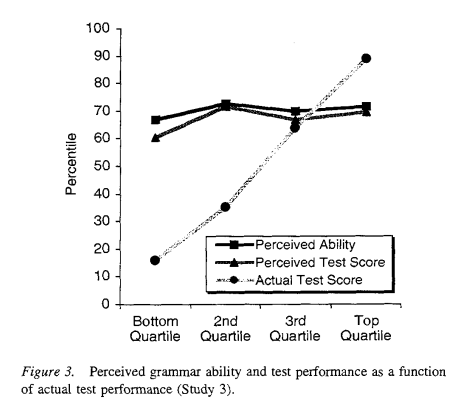
Notice that, the people with the least scores predicted that they were almost equal to the experts and the actual experts, in reality, scored themselves lower than they actually are.
This is disturbing because the experts value themselves as mediocre. While the fools consider themselves experts. This disproportionate skew in intelligence and the fact that there are more ignorant people than there are experts adds to the cluttered noise of unwanted things being scrutinised by clueless people, over the internet.
Be that as it may, this provides false confidence on the truly clueless and unskilled. If it is even difficult to contemplate or acknowledge that one is ignorant then there won’t be an improvement of any kind. As they describe in the report, “unskilled individuals suffer a dual burden: Not only do they perform poorly, but they fail to realize it.”
It is, therefore, necessary to be cautious when evaluating oneself based on gut instinct only. We probably will end up overestimating ourself and underestimating our competition. Neither of which will be constructive, even remotely.
It is good to know the pitfalls of the mind and recaliberate our scales.